
What Ritchie County Tax Records Show
Value and collection are separate jobs. The Ritchie County Assessor sets the value used for property taxation, levying bodies set the rates, and the Sheriff Tax Office collects the payments. The state's county assessor description summarizes both the assessment and the exemption duties. Note the year, account, and district. A property tax search in Ritchie County should compare a value against a balance only after those details match the same parcel.
| Record Field | What It Tells You | Where to Look |
|---|---|---|
| Land, improvement, total assessed value | Assessment components for the tax year | Assessor record or estimator |
| Exemption and class | Tax treatment recorded for the parcel | Assessor; ask about eligibility |
| Tax year and ticket | Bill record attached to a year/account | Sheriff Tax Inquiry |
| Total billed and total paid | Amounts posted for that ticket | Sheriff inquiry detail |
| First half, second half, total due | Payment status fields visible on the inquiry | Sheriff Tax Office |
The sheriff's page adds a name and billing address. Each record also shows the account, map and parcel, and property description, and the Ritchie County Tax Inquiry displays the ticket, year, billed, paid, and due columns. A "Total Due" figure is a portal balance only. Ask for written tax status when a transfer, redemption, or title review depends on the exact amount.
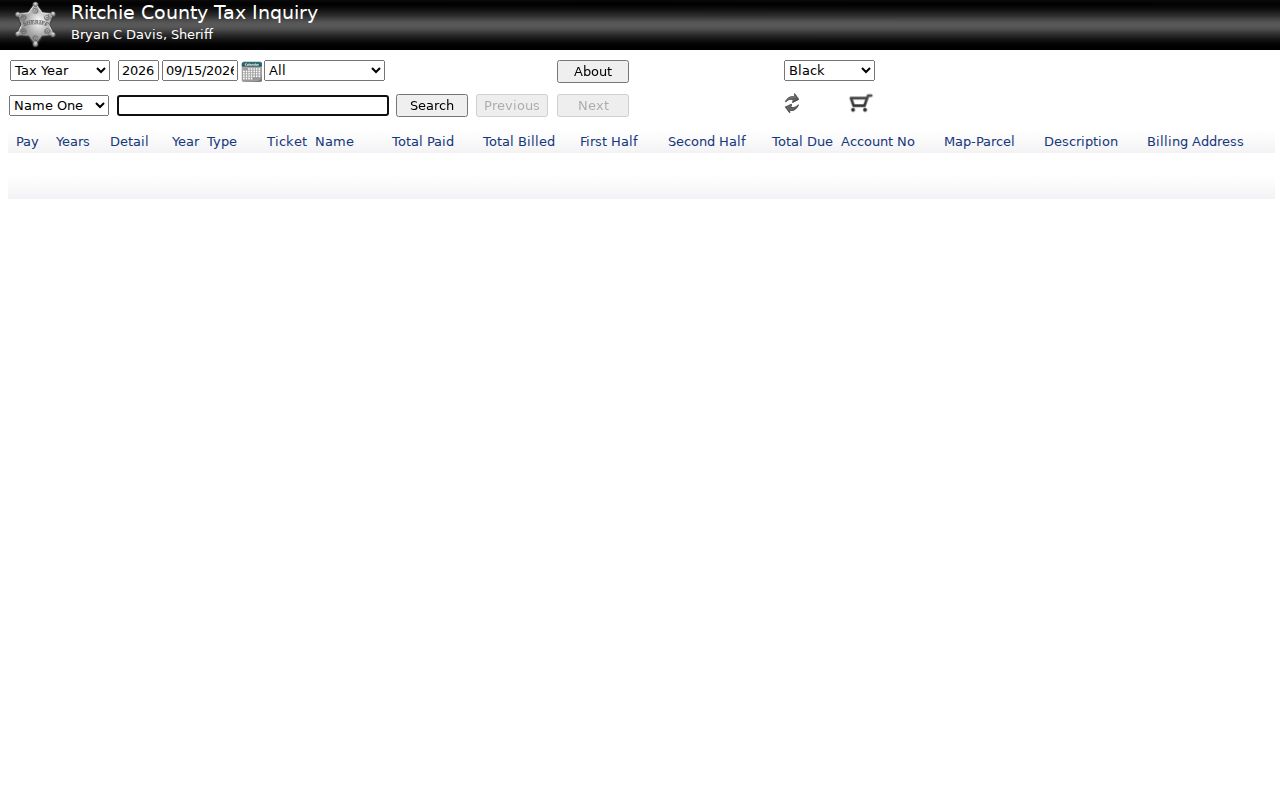
Keep the tax year and ticket number handy. Those details let the Sheriff Tax Office answer a follow-up about a particular Ritchie County bill.
Ritchie County's 60 Percent Assessment Level
West Virginia Code §11-3-1 provides that property is assessed annually as of July 1 at 60 percent of true and actual value. The statute describes true and actual value as the price under ordinary voluntary sale conditions, rather than a forced sale. The state Tax Division gives a plain example: property with a $100,000 market value generally has a $60,000 assessed value.
This statewide rule explains why the assessment field is not a current listing price or an appraisal. The assessor may display land, improvement, and total values, but the exact parcel-card fields were not reached during research. The value can differ from a recent deed price because the transaction may involve a partial interest, family transfer, minerals, acreage, unusual consideration, or another non-typical sale.
The West Virginia assessment statute is shown in the captured reference below.
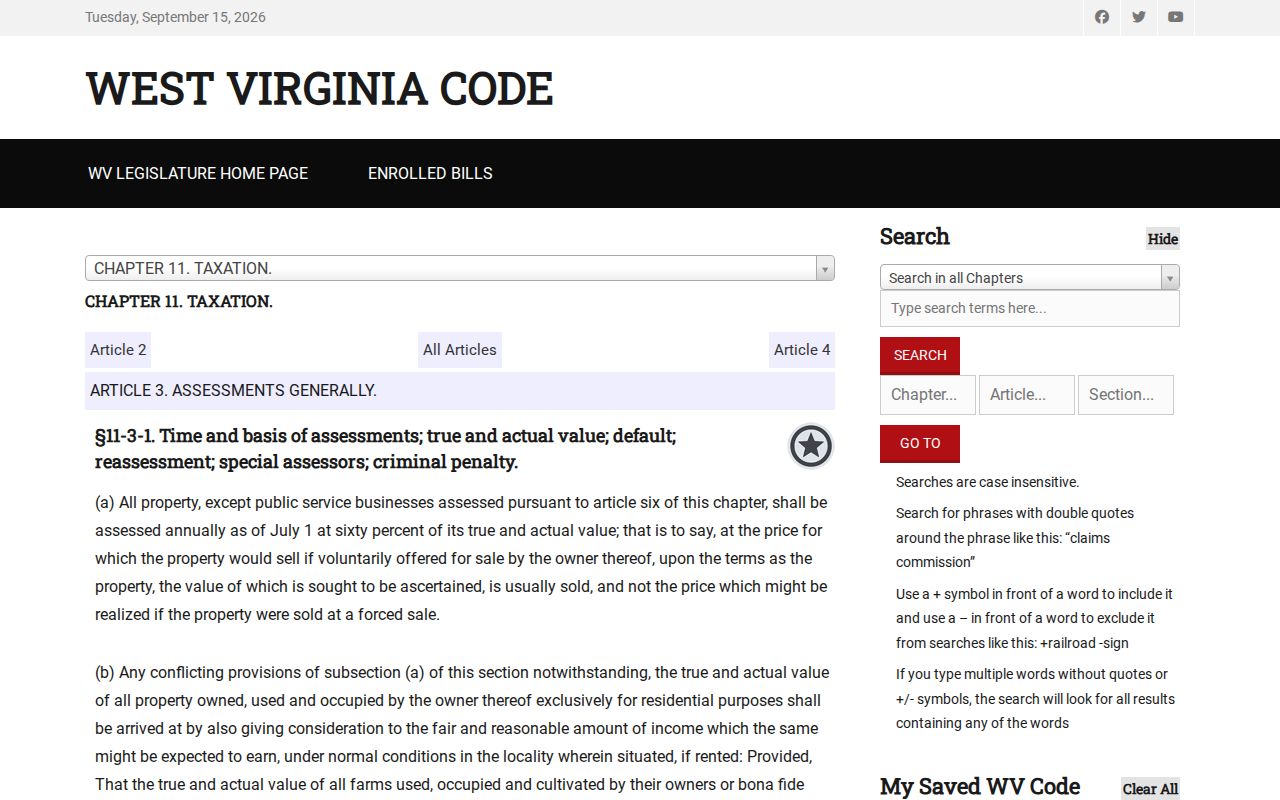
Use the 60 percent rule for context only. It is a statutory fraction, not a shortcut to a market appraisal.
Assessor Values and Ritchie County Tax Estimates
The Ritchie County assessor's site offers a property search and a Tax Estimator. The estimator wants value, year, district, and class. It can sketch a rough calculation. It is still not the sheriff's posted bill. The assessor's office notes that levying bodies set the taxes, so value questions and payment questions belong with separate offices.
The office sits at 115 East Main Street, Room 203, in Harrisville. Hours run 8 a.m. to 4 p.m. on weekdays. Verify the current contact and extension before visiting. The assessor handles value and assessment corrections, while the sheriff keeps the tax ticket and collections.
The Ritchie County Tax Estimator page lists the value, year, district, and class inputs.
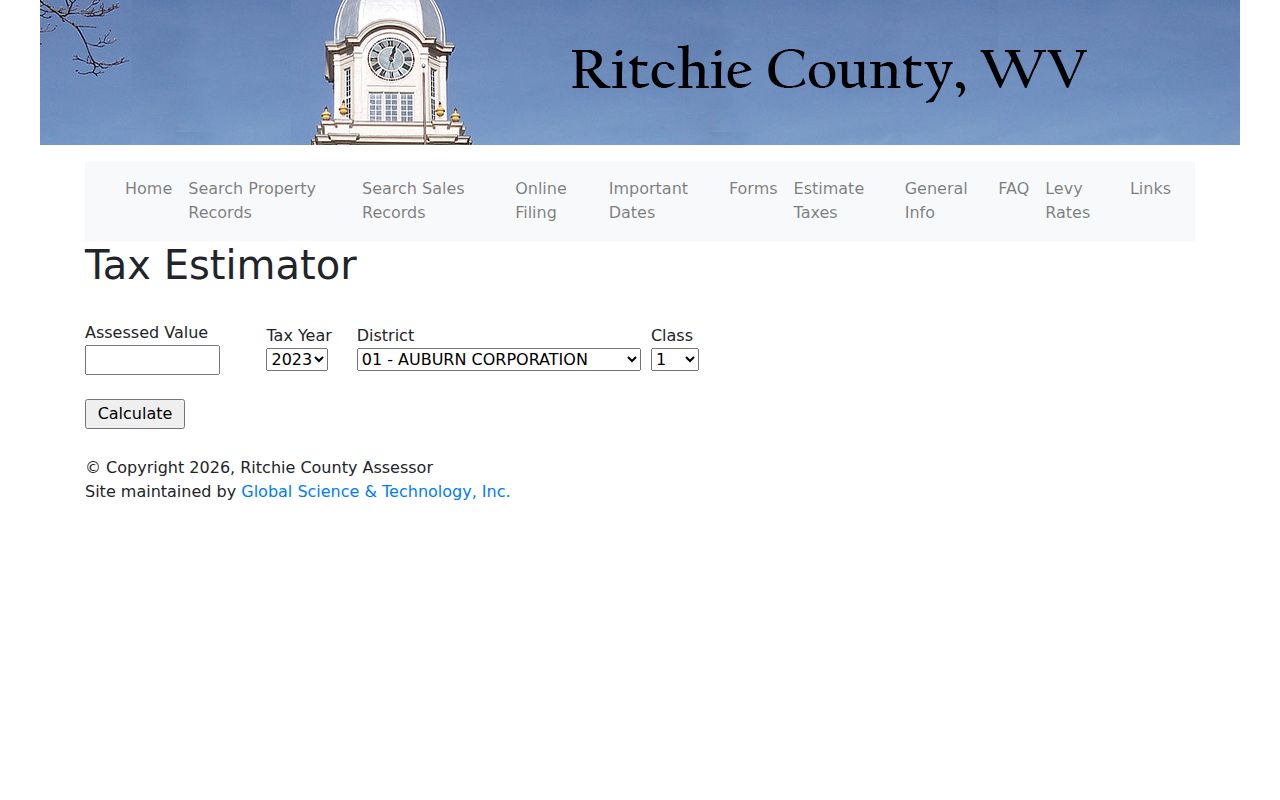
The assessor's office page has current contact details. It also explains the split between value and levies. Before comparing figures, ask whether a field is assessed value, tax class, or a billed amount.
Looking Up a Ritchie County Tax Bill
Lead with the account number or map and parcel. Names can return several tickets. Ritchie County tax pages may list multiple periods and balances for one parcel, so keep the year and ticket with you.
- Find the parcel in the assessor search and record the owner, account, district, and map/parcel.
- Open the Sheriff Tax Inquiry and choose the available name, account, or map/parcel search path.
- Read the ticket, tax year, total billed, total paid, first and second halves, total due, and billing address.
- Use the payment link or contact the Sheriff Tax Office for the transaction path and current amount.
- Request a written tax certificate if an official status is needed for a transfer or title review.
- Assessed value
- The county value used in the property-tax calculation, generally set at 60 percent of true and actual value.
- Levy
- A tax rate set by a levying body and applied to the taxable assessment.
- Tax ticket
- The sheriff's record for a billed tax year and parcel account.
- Exemption
- A statutory tax treatment recorded by the assessor when eligibility is met.
- Tax lien
- A claim or filing that should be checked in the clerk index and relevant court record.
The Sheriff Tax Office sits at 109 East North Street, Suite 101, in Harrisville. The phone is 304-643-2262. The state's county sheriff description covers tax collection and delinquent-property duties. Portal payment and clerk copy payment are separate processes.
Ritchie County Homestead and Disability Exemptions
Homestead and disability exemption questions go to the assessor. Eligibility follows state rules the office applies. A listed exemption is a claimed classification only. It does not prove title or occupancy. Ask which application and proof the office wants for a given tax year.
When you compare a bill to an assessment, check whether an exemption shifts the taxable amount. Note the value, class, exemption, year, and ticket separately. A name on the mailing line can be a trustee, an estate, or another contact, and it need not match the parcel's user.
Ritchie County property tax records work best read side by side. Value and bill are different numbers. For the line between assessed and market value, the property value reference explains the distinction.
Ritchie County's Assessment and Appeal Calendar
Assessment in Ritchie County follows a statutory calendar. Annual assessment work must be done by January 30. The books then go to the Board of Equalization and Review by February 1. The assessor also sends annual transfer and new-construction information to the Tax Commissioner by December 1. Nothing about that calendar is instant. An online roll, in other words, is not a live record of every closing in the county.
| July 1 | Annual assessment date under §11-3-1. |
|---|---|
| January 30 | County assessment work completion target stated by the assessor. |
| February 1 | Assessment books go to the Board of Equalization and Review. |
| March 31 | General filing deadline stated in §11-3-25b for an Office of Tax Appeals valuation petition for the tax year. |
| December 1 | Assessor's transfer and new-construction information is supplied to the Tax Commissioner. |
A Ritchie County taxpayer who disagrees with an assessment starts informally. Ask the assessor to explain the valuation and request a review. That conversation resolves many disputes. If it does not, the case can move to the county Board of Equalization and Review. From there, it may proceed to the state Office of Tax Appeals. Each stage has its own paperwork. Confirm the current form, filing method, and deadline with the assessor or the official state source. The right date depends on the tax year and the type of issue raised.
Keep the dates with the record. Record the assessment year, notice date, and appeal contact as soon as a valuation concern arises. Verify the current procedure with the Ritchie County Assessor before relying on a calendar summary.
Delinquent Ritchie County Tax Records
Delinquent Ritchie County tax work spans two offices. Begin with the tax ticket in the sheriff's system, then move to the clerk's index. There you can search the delinquent-tax, delinquent-land, land-redemption, tax-deed, and notice categories. The County Clerk records notices to heirs to redeem and files delinquent-property deeds. Expect a paper trail. A redemption notice, a tax sale, a payment, and a final deed may each appear as a separate record. Each carries its own date. Keep the parcel number, ticket, legal description, and party names in one file. That keeps the chain readable.
Foreclosure, quiet title, partition, and confirmation actions live in the circuit records through WVPASS. Compare the court file against deed-of-trust assignments, releases, and reports of sale under trust deed. Those sit in the County Clerk index. A balance showing in the sheriff portal does not prove a tax sale finished. For anything time-sensitive, request a tax certificate or written status. A notice may name an estate or fiduciary. Check the clerk's probate and AFF/HEIR categories. Do not assume the owner of record changed hands.
Ritchie County Tax Record Access and Fees
Ritchie County offers two public entry points online: the assessor search and the tax inquiry. Neither portal guarantees full coverage of every year or document. Value and correction questions go to the assessor's office. The Sheriff's Tax Office explains bills and certificates. The County Clerk holds tax liens, delinquent-land instruments, and recorded deeds. When an online result comes up empty, a counter visit or written request still works.
West Virginia FOIA gives the public inspection and copying rights, subject to exemptions. A public body must generally answer in writing within five business days. Inspection happens during usual business hours. Search and retrieval labor fees are not allowed. Reasonable copying, media, postage, and special-format costs can apply. Clerk record-copy charges may follow a separate schedule, so verify each fee with the office.
Ritchie County property tax records carry the most weight with their dates and sources attached. Save the portal printout and ticket number. Keep the assessor account and any written confirmation with the property file. Disagreeing numbers usually trace back to a correction or a different tax year. Ask which one applied before concluding anything.