
Tracing Former Ritchie County Property Owners
A backward chain starts from a deed you know. Move from that instrument's grantor to the same party's earlier purchase. Give every transfer its own row. This outline is a worksheet, not a sample Ritchie County transaction, so fill it with book, page, and instrument details from the clerk's deed records.
| Transfer Date | Grantor to Grantee | Instrument | Book/Page |
|---|---|---|---|
| Latest recorded deed | Prior owner to current grantee | Deed or conveyance | Copy from index |
| Earlier conveyance | Earlier grantor to prior owner | Deed, correction, or estate transfer | Follow prior reference |
| Older book entry | Previous parties in the chain | Book-era deed or plat-linked deed | Confirm with clerk |
Keep the instrument date and the recording date separate. A deed may sit signed for weeks before it is entered. Preserve the exact name and legal description too. A parcel can split, combine, or keep a mineral interest. Surface ownership may change hands while the minerals stay put.
The Ritchie County Document Inquiry page displays party roles and instrument fields. Each result also shows the date and book/page fields.

An index row is only a pointer. Read the recorded instrument itself before adding any former owner to your Ritchie County deed chain.
Reverse the Ritchie County Grantor and Grantee
Start with the current deed's grantee. That party's earlier acquisition is the next link. Reverse the roles at each step. Today's grantee becomes the next search name, and the older instrument's grantor becomes the prior party to trace. The clerk's IDX has separate grantor, grantee, creditor, and debtor sub-index choices, so use grantor and grantee for conveyances and keep financing or lien searches distinct.
- Locate the newest deed that matches the parcel's legal description.
- Record the grantor, grantee, instrument date, recording date, book/page, and land description.
- Search the grantee as a prior grantee, then find the deed by which that party acquired the same tract.
- Compare legal descriptions and note splits, corrections, life estates, mineral reservations, or plat references.
- Continue until the online index ends, then ask which older book, card index, or microfilm series covers the next year.
Never assume a repeated name is the same person. Record middle initials, spouse mentions, trustees, administrators, company suffixes, and former surnames when the document supports them. Watch for trusts and estates. When one appears, search the fiduciary or probate records alongside the land index.
- Grantor
- The party conveying or assigning the interest in an instrument.
- Grantee
- The party receiving the interest described in that instrument.
- Reverse index
- A name index searched in the opposite party role to find an earlier transfer.
- Chain of title
- The sequence of recorded instruments that connects successive interests.
- Correction deed
- A later filing that may correct an earlier name, description, or other stated detail.
How Far Back Ritchie County Records Go
Ritchie County was formed in 1843. The County Clerk states that county records date to that founding. The public IDX does not name its earliest online year. That gap matters. Physical deed books can be older than the searchable portal. If the chain stops online, ask the clerk which book and index cover the target year. Ask whether the volume sits at the counter, on microfilm, or elsewhere.
Ritchie was carved from Wood, Harrison, and Lewis counties. Land in a deed may have sat in another jurisdiction when it was written. Ritchie later lost land to Doddridge and Pleasants. Part of Gilmer County was added in the 1860s. The place and the transaction date decide which county clerk to search.
Do not call the web index complete since 1843. Its start year is unstated. Its images may have separate access rules.
Ritchie County Deed, Land, and Plat Books
The clerk's book list covers Deed Book, Land Book, Plat Book, Plat & Survey Book, Road Record Book, Road Order Book, and related series. Older grantor-grantee indexes vary. A grantor-grantee index may be alphabetical, card-based, or ordered by book, so ask before you search. Old records rarely cite a modern street address, so a description may instead name acreage, a stream, a road, a town lot, or a neighboring owner.
Some records never appear in an online search. The clerk handles counter and mail requests for those. Give the parties, instrument type, date range, book and page, certification choice, and copy format. Fees are revised periodically. Confirm current charges and ask whether an oversized plat bills differently.
FamilySearch catalog and state archives may hold historic books and microfilm. Search by Ritchie County, West Virginia. Confirm the format. It may be indexed, image-only, or restricted. A listing is a lead only. It does not prove every year can be viewed remotely.
Ritchie County Historic Names and Maps
Old place names can explain a break in a chain. Harrisville had five names. It was Solus at its first post office. Later names were Ritchie Court House, Harrisville, Ritchie Courthouse, and Harrisville again in 1985. Search every form. Old deed descriptions, newspapers, maps, and family files may hold it. The name is a location clue, not a different parcel key.
The Ritchie County Historical Society links to 1899 Library of Congress maps. They cover Harrisville, Pennsboro, and Cairo. Its collections reach further. History books, family files, maps, newsletters, and a Ritchie vital index are all listed. These can settle a family spelling or an old street reference. The clerk's land book still governs the conveyance.
The Historical Society research page lists its collections.
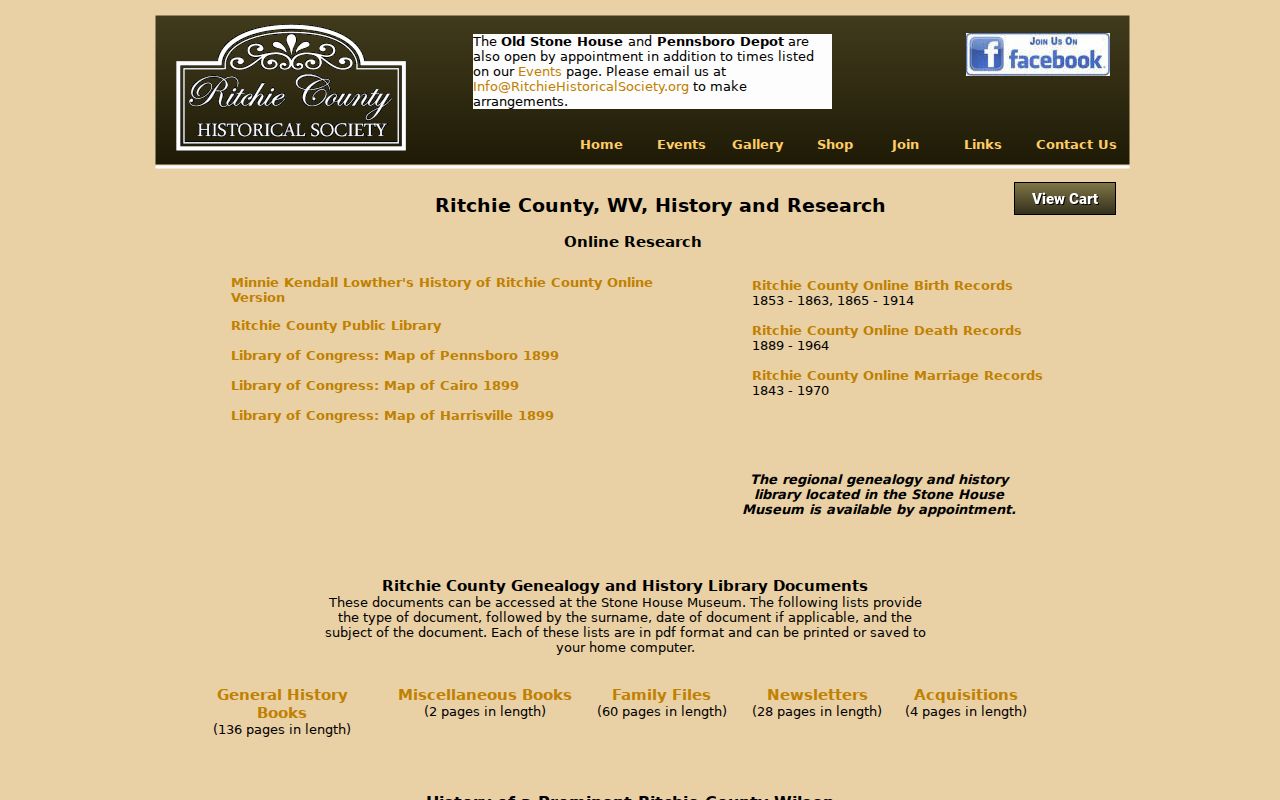
The county's recorded births span 1853 through 1863, pause, then resume from 1865 to 1914. Recorded deaths run from 1889 to 1964. Marriages reach back to 1843 and continue through 1970.
That birth gap deserves care. No one should assume the missing years exist somewhere unindexed. An index can point the way, yet it never replaces a certified document you can actually obtain.
Library Sources for Former Ritchie Owners
The Ritchie County Public Library keeps a WV History Room. It also holds a genealogy collection and old newspapers on microfilm. The Harrisville library sits at 608 East Main Street. The Pennsboro branch is at 411 Main Street. Staff can point you to obituary runs, county histories, and cemetery books. They can also share any city or reverse directories the library holds. No continuous directory series exists. Get a title and year before you lean on one.
Why does a directory matter? It can supply a historical address, an occupation, a spouse notation, or an owner-versus-renter clue. Pair that year with a census entry or newspaper item. Then return to the assessor or the deed book for the parcel itself. A name in a family file does not prove a recorded title transfer. The library services page describes its history and genealogy resources in detail.

Write down each collection name and the years you searched.
Probate and Heirship in a Ritchie County Chain
Estate transfers explain why a grantee name can change without a conventional sale. The County Clerk IDX includes Will, Fiduciary, Small Estate, and AFF/HEIR categories. Local Affidavit of Ownership-Heirship instructions point to the Deed Book Code AH search location. An executor or administrator may also record a deed. Before tying an estate paper to a prior owner, stop. Compare its legal description with the parcel.
A death-transfer question follows a simple arc. Use the historical death index or an eligible certificate as a date clue. Locate the will or fiduciary file next. Search AFF/HEIR entries and executor deeds, then keep following the recorded conveyances. The County Clerk posts a death-certificate request form with a $5 copy fee. It also posts a separate marriage-certificate request form. Marriage records often explain a name change. Still, the deed party spelling and any correction instrument deserve their own check.
WV Code §16-5-27 generally opens birth records after 100 years. Death, marriage, and divorce records open after 50 years. The state Vital Registration office holds the official vital records. Recent certificates carry eligibility limits. Restricted portions may stay protected. Historical indexes do not erase those limits.
Limits of a Former Owner Search
An index-built chain can stay incomplete. A book may be offline. The legal description may change. A parcel may split into surface and mineral interests. A deed can also refer to the prior town name, an estate, a trustee, or land that sat in another county at the time. Preserve the uncertainty in your working record rather than filling a gap with a same-name person.
Online cutoff not stated. The County Clerk says its records date to the county's founding, but the IDX does not publish its earliest searchable year. Older owners may require the clerk's deed books, local microfilm, or archive research.
Is the question about the present owner instead of the chain? See the current owner record method. For an actual conveyance copy, contact the County Clerk and verify the current request rules.